
 Help & Support
 SEARCH
OpenAI unlocks new scientific frontiers with Prism
SHARE IT
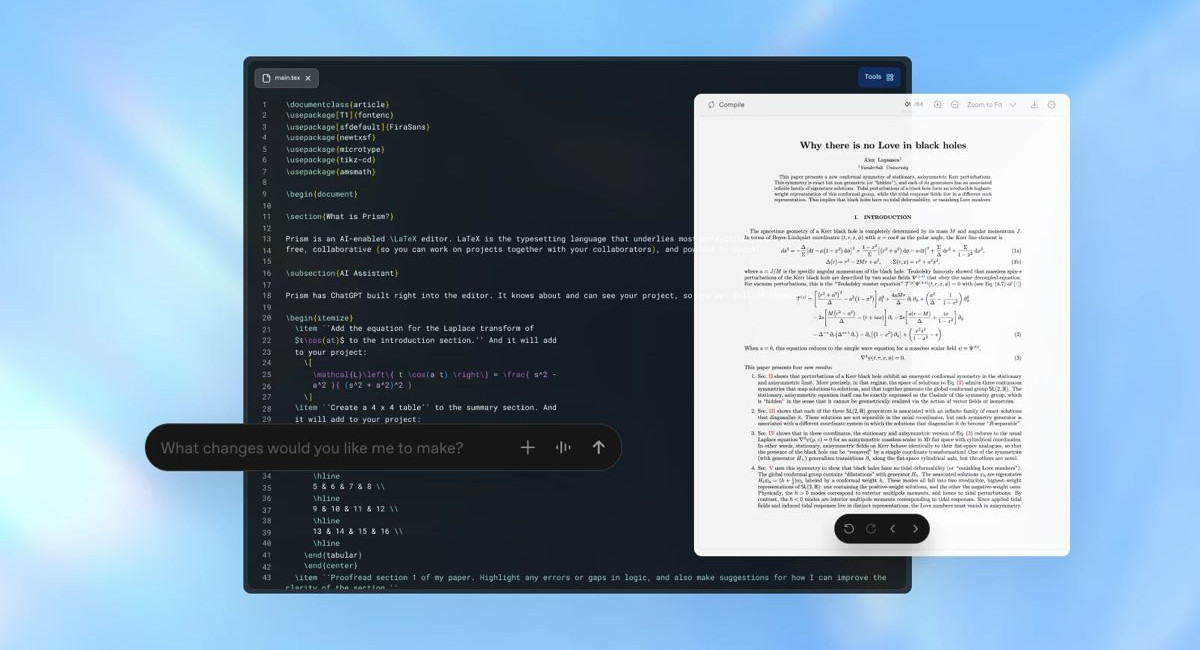
The landscape of artificial intelligence is shifting from general assistance to specialized expertise, and OpenAI is the latest to signal this evolution with the introduction of Prism. This new tool represents a strategic pivot toward the scientific community, offering a sophisticated interface designed to streamline complex research workflows. By creating a dedicated environment for data analysis and hypothesis testing, OpenAI is not just providing a chatbot, but a functional laboratory assistant that resides within the computer.
Prism arrives at a time when the AI industry is increasingly focused on agentic behavior—the ability of a model to take actions, execute code, and manage multi-step projects independently. While earlier iterations of AI required constant hand-holding, Prism is built to understand the broader context of a scientific inquiry. It functions similarly to Anthropic’s Claude Code, acting as a terminal-based or integrated tool that can navigate file systems, read documentation, and write executable code to solve technical problems.
What sets Prism apart is its specific optimization for the rigors of scientific methodology. Researchers often find themselves bogged down by the clerical work of science, such as formatting massive datasets, debugging simulation scripts, or cross-referencing literature. OpenAI has positioned Prism as a remedy for this cognitive load. The tool is engineered to handle the heavy lifting of computational science, allowing biologists, physicists, and chemists to spend less time on syntax and more time on discovery.
The development of Prism reflects a broader trend where AI companies are seeking to prove the utility of their models in high-stakes environments. For OpenAI, the goal is to demonstrate that their underlying models, like o1, possess the reasoning capabilities necessary for groundbreaking research. Prism acts as the bridge between raw intelligence and practical application. It is designed to be cautious and precise, traits that are non-negotiable in a field where a single coding error can invalidate months of experimental data.
Security and reliability remain at the forefront of this rollout. Because Prism has the capability to interact directly with a user's digital environment, OpenAI has implemented safeguards to ensure that the tool operates within strictly defined boundaries. This is particularly important for institutional research, where data privacy and intellectual property are paramount. The tool provides a transparent audit trail of the actions it takes, giving scientists the ability to verify every step of the AI’s logical progression.
Competition in this space is intensifying rapidly. With Anthropic’s recent release of tools aimed at developers and researchers, OpenAI’s launch of Prism is a clear defensive and offensive maneuver. It signals that the race for AI supremacy will be won in the trenches of specialized industries rather than through general consumer apps. By winning over the scientific community, OpenAI secures a position at the heart of future innovation, ensuring that the next generation of breakthroughs will be powered by their technology.
Ultimately, Prism represents the beginning of a new era for the scientific method. As these tools become more integrated into the daily routine of researchers, the pace of innovation is likely to accelerate. We are moving toward a future where the barrier between a scientific concept and a functional experiment is thinner than ever before. Prism is more than just a software update; it is a testament to the idea that AI’s greatest contribution to humanity will be its ability to help us understand the world around us.
MORE NEWS FOR YOU