 Help & Support
 SEARCH
Adobe expands its AI footprint inside ChatGPT
SHARE IT
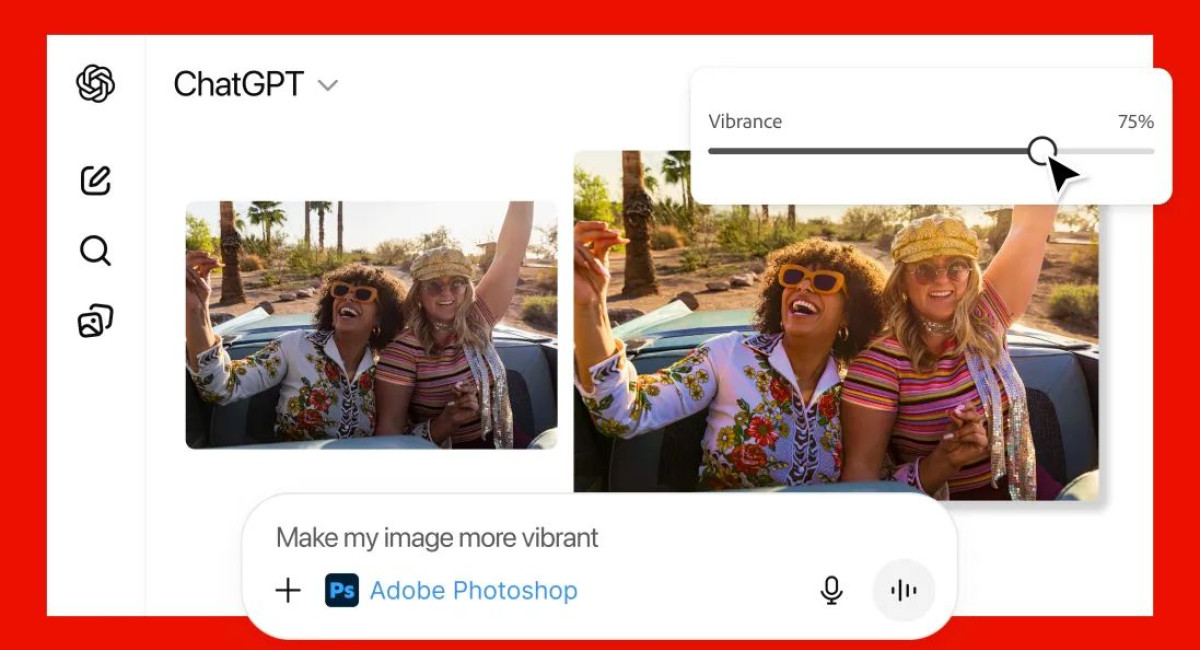
Adobe is deepening its commitment to artificial intelligence by bringing some of its most iconic creative tools directly into ChatGPT. The company announced on Wednesday that Photoshop, Express and Acrobat capabilities are now integrated into the chatbot, giving users the ability to request sophisticated image edits, design tweaks, and PDF modifications through natural-language prompts.
The move represents Adobe’s latest effort to meet users where they already are. As millions increasingly rely on conversational interfaces for everyday tasks, Adobe is positioning its products to become seamlessly accessible inside that environment. For ChatGPT users, the result is a new layer of convenience: instead of opening a separate app or navigating complex menus, they can simply ask the chatbot to perform a targeted action within a specific Adobe product.
With Photoshop now embedded, ChatGPT can handle a wide range of image editing tasks. Users may ask it to adjust exposure, dial up or tone down brightness and contrast, or apply stylistic filters. More precise commands are supported as well, such as removing a background, blurring a scene, or retouching only a specific section of an image. Once an edit is applied, ChatGPT provides interactive sliders that allow users to fine-tune the intensity of the effect. The idea, Adobe says, is to maintain control while reducing the friction typically associated with advanced photo editing.
Support for Adobe Express brings a different set of creative tools into the mix. Instead of performing manual layering or layout work, users can request themed designs, animated elements, or new compositions generated from Express’s content library. ChatGPT can fetch assets, rework existing templates, or assemble fresh visuals from scratch. For those without design experience, the integration offers a guided and simplified entry point into the world of digital creation.
Acrobat’s arrival adds yet another dimension. Through ChatGPT, users can merge PDFs, extract tables or text, rearrange pages, or carry out straightforward edits without leaving the conversation window. Tasks that once required opening a full PDF editor can now be completed in a few lines of instruction. Adobe emphasizes that these tools aim not only to boost productivity but also to reduce the intimidation factor that often comes with working on complex documents.
At the same time, Adobe acknowledges that not all users will want to perform every action solely through ChatGPT. For those who prefer direct control or need advanced functions unavailable through the chatbot, a transition option appears at any stage. With one click, users can switch into the corresponding Adobe app and continue their work exactly where the chatbot left off.
All three integrations—Photoshop, Express and Acrobat—are rolling out globally. They work across ChatGPT’s desktop, web and iOS applications, though Android support is currently limited to Adobe Express. The company says Android access to Photoshop and Acrobat will follow.
The expansion reflects a broader wave of AI-enabled releases from Adobe this year. In October, the company debuted dedicated AI assistants within Express and Photoshop, along with an early preview of a cross-application system known internally as Project Moonlight. Taken together, these developments highlight Adobe’s strategy of interweaving AI through its entire product ecosystem, ensuring that core creative workflows remain competitive in an era of rapid technological change.
The partnership with ChatGPT raises questions about business dynamics behind the scenes. Neither Adobe nor OpenAI has revealed whether a formal revenue-sharing model exists, leaving unclear how the two companies will split potential gains as usage scales. What is clear is that Adobe sees ChatGPT as an important gateway to new audiences.
For OpenAI, the addition of Adobe tools strengthens a growing marketplace of third-party apps within ChatGPT. The system began supporting external services in October, launching initially with platforms like Canva, Spotify, Expedia and Figma. As more companies race to integrate, the competitive landscape within ChatGPT is becoming increasingly crowded. Users can now choose between multiple tools for the same task—for example, both Canva and Photoshop can handle image edits. For many, the deciding factor may be familiarity, but newcomers without allegiance to any particular platform might simply select whichever tool ChatGPT suggests first.
Still, the trend is unmistakable: creative software is evolving toward conversational control, and Adobe intends to lead that shift. By embedding core features of its flagship apps directly into ChatGPT, the company is betting that the future of content creation will be driven not by menus and toolbars, but by plain language.
MORE NEWS FOR YOU