Help & Support
SEARCH
Beyond plain text: Inside OpenAI's interactive leap
SHARE IT
The era of the plain text chat window is undergoing a quiet revolution. For years, conversational artificial intelligence has relied on a predictable loop: a user types a prompt, and the machine streams back blocks of text, occasionally punctuated by bullet points or markdown tables. OpenAI is now upending that paradigm with the rollout of Intelligent UI for ChatGPT, alongside the decision to unlock its next-generation GPT-6 model for all global users at no cost. This shift transforms what was essentially a digital conversationalist into an interactive, visual workspace.
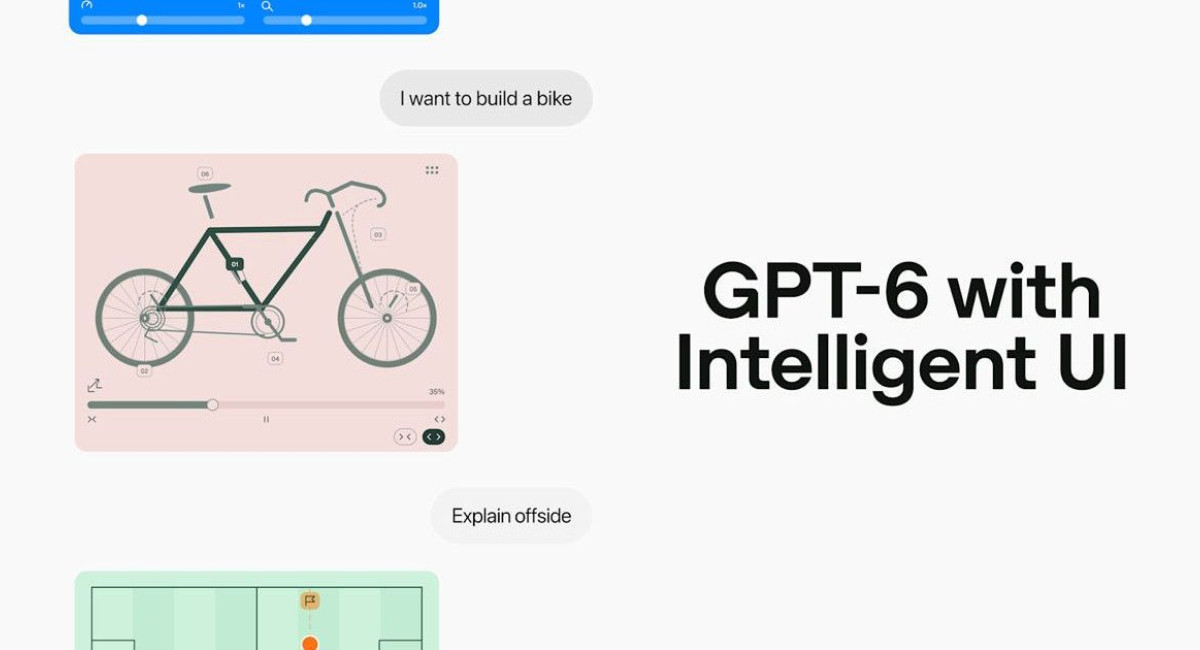
At the center of this transformation is Intelligent UI, a front-end overhaul designed to replace lengthy written responses with dynamic elements. Rather than drafting lengthy paragraphs to explain complex quarterly financial fluctuations,ChatGPT can now generate native pie charts, responsive bar graphs, and clickable controls directly in the conversation stream. Users can hover over metrics to isolate data, fill out generated forms on the fly, or trigger programmatic actions with a single click without having to type follow-up commands. The dialogue window functions less like a messaging app and more like a collection of agile mini-apps built in real time around the user's intent.
The core motivation behind this interface evolution is cognitive efficiency. Processing large walls of descriptive text demands substantial mental effort, whereas visual structures allow people to absorb information and make decisions much faster. In software development and design scenarios, this shift is especially striking. When an engineer asks the system to build an interface component, ChatGPT does not merely produce code in a raw snippet box; it renders a live preview of the interactive element, allowing direct testing inside the thread.
Powering this interactive environment is GPT-6, which OpenAI has made available to free-tier accounts rather than reserving it behind subscription paywalls. Under the hood, the architecture demonstrates a 25 percent increase in output generation speed while requiring roughly a quarter fewer tokens to complete equivalent computational tasks. By lowering the processing overhead required per query, OpenAI has significantly reduced server costs, making widespread public deployment economically viable.
The timing of this release also reflects escalating competition across the industry. With rival offerings like Google Gemini and Anthropic Claude Opus continually closing performance gaps, expanding free access to cutting-edge model capabilities represents a strategic play to maintain user retention and reinforce ecosystem loyalty. Benchmarks for the new architecture point to measurable gains in logical reasoning, advanced mathematical problem solving, and complex software programming.
Beyond pure conversational speed, the model exhibits improved multimodal understanding. The engine can now digest rough sketches, architecture schematics, and screenshots with notable accuracy. A developer can upload a photo of a whiteboard layout drawn during a meeting, and the model will interpret the layout, generate the corresponding code,and render an interactive prototype using Intelligent UI components. In infrastructure design, uploading a static diagram of cloud servers allows the system to identify configuration bottlenecks, suggest scaling strategies, and map security boundaries automatically.
By weaving real-time visual controls directly into conversational outputs, OpenAI is moving artificial intelligence beyond simple question-and-answer mechanics. The union of dynamic interface components and expanded computational access marks a clear step toward turning conversational platforms into versatile, interactive software environments.
MORE NEWS FOR YOU