Help & Support
SEARCH
Google opens SynthID to the public
SHARE IT
In an era where synthetic media continues to blur the boundary between genuine human capture and algorithmic hallucination, authenticating digital content has shifted from a technical niche into an urgent civic necessity. Google has taken a decisive step to address this reality by opening SynthID Detector to the public worldwide. Engineered originally within Google DeepMind, this web-based platform transitions from a specialized verification pipeline previously reserved for credentialed newsrooms and academic labs into a publicly accessible utility. By democratizing access, the search giant aims to arm internet users against the escalating flood of hyper-realistic generative media and sophisticated deepfakes.
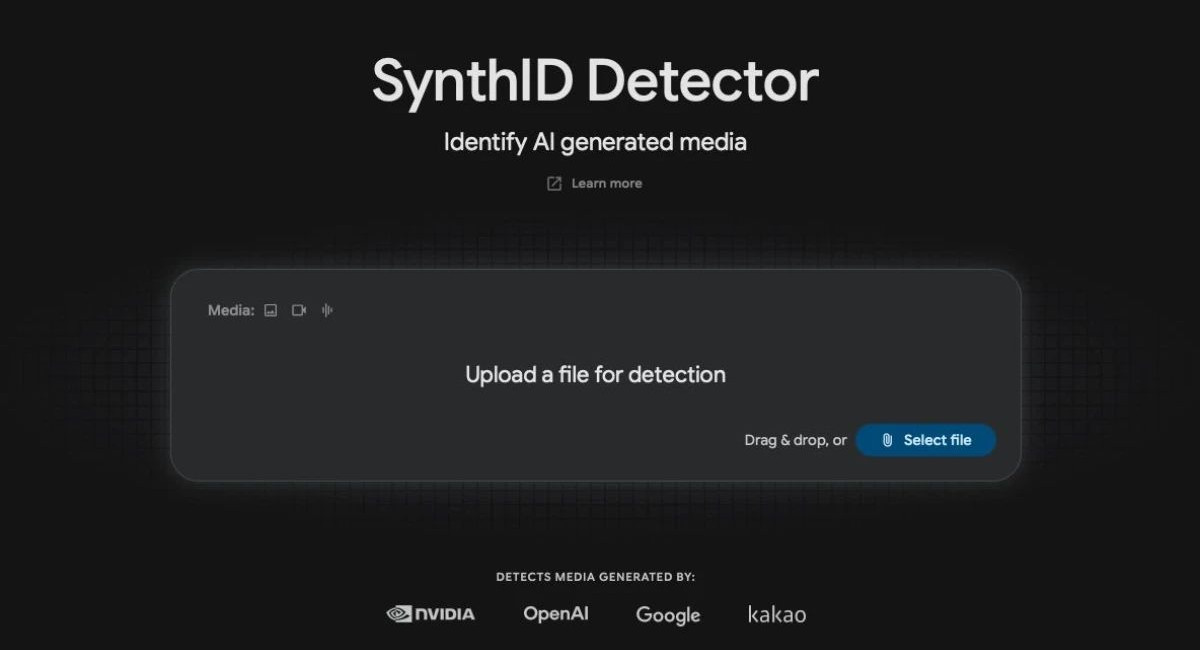
Accessible without charge through synthid.com, the platform allows anyone to upload media files and test them for embedded cryptographic provenance tags. Rather than operating as an isolated walled garden, Google has built cross-industry interoperability into the foundation of the detector. The system currently recognizes proprietary watermarks originating not only from Google own foundational models, but also from major industry players including OpenAI,NVIDIA, and Kakao, with Apple scheduled to join the alliance shortly. By scanning files against these integrated standards, the verification engine delivers an authentication verdict within seconds.
The architecture accommodates a comprehensive suite of modern multimedia standards, supporting visual formats like JPG, PNG, WEBP, and HEIC, video containers including MP4, MOV, and WEBM, alongside diverse audio formats like WAV, MP3, OGG, FLAC, and M4A. To prevent automated scraping and maintain system stability, the service requires account authentication via Google, OpenAI, or Apple credentials, establishing a daily quota capped around ten scans per user. Privacy remains central to the protocol; all submitted files are instantly purged from the servers following analysis, preserving solely an encrypted hash for twenty-four hours to enforce daily fair-use limits.
The scale of media already carrying these signatures illustrates how deeply generative software has penetrated everyday communication. Since its experimental deployment in 2023, SynthID has embedded digital markers across more than 180 billion generated images and videos. In the auditory domain, synthetic voice and music synthesis systems, such as Lyria and NotebookLM audio generation, have produced watermarked content equivalent to roughly 240,000 years of continuous playback. Concurrently, native detection hooks already operational across Gemini,Chrome, and Google Search quietly resolve upwards of one million daily verification queries.
Technically, SynthID circumvents the vulnerabilities inherent in fragile metadata stamps, which bad actors routinely scrub with ease. For imagery and video footage, the invisible signature weaves directly into pixel values during generation. This structural integration ensures the watermark survives severe post-processing, including aggressive cropping, color-grading passes, frame rate alterations, and destructive compression algorithms. When handling sound,the system converts raw waveforms into spectrograms, discreetly weaving in imperceptible frequency modulations that resist background noise and tempo shifts.
Despite these engineering feats, the technology operates under deliberate, realistic boundaries. A negative scan merely signifies the absence of this specific family of signatures; it does not certify human origin. The digital wild west remains saturated with open-source models, independent platforms, and unaligned creators who bypass watermarking entirely. Furthermore, radical alterations can occasionally degrade or erase the embedded trace. The tool also provides a binary confirmation rather than a granular provenance report, meaning it identifies that algorithmic intervention occurred without clarifying whether an image was created entirely from scratch or merely modified through an AI-assisted cleanup tool.
Nevertheless, opening SynthID marks a critical pivot in digital verification. Instead of depending entirely on centralized gatekeepers to evaluate online authenticity, Google places an industrial-grade microscope directly into the hands of ordinary consumers. While it cannot single-handedly solve the deepfake puzzle, it establishes a functional baseline for collective media literacy at a moment when seeing is no longer believing.
MORE NEWS FOR YOU