 Help & Support
 SEARCH
Nano Banana Pro raises the bar for high-fidelity AI image generation
SHARE IT
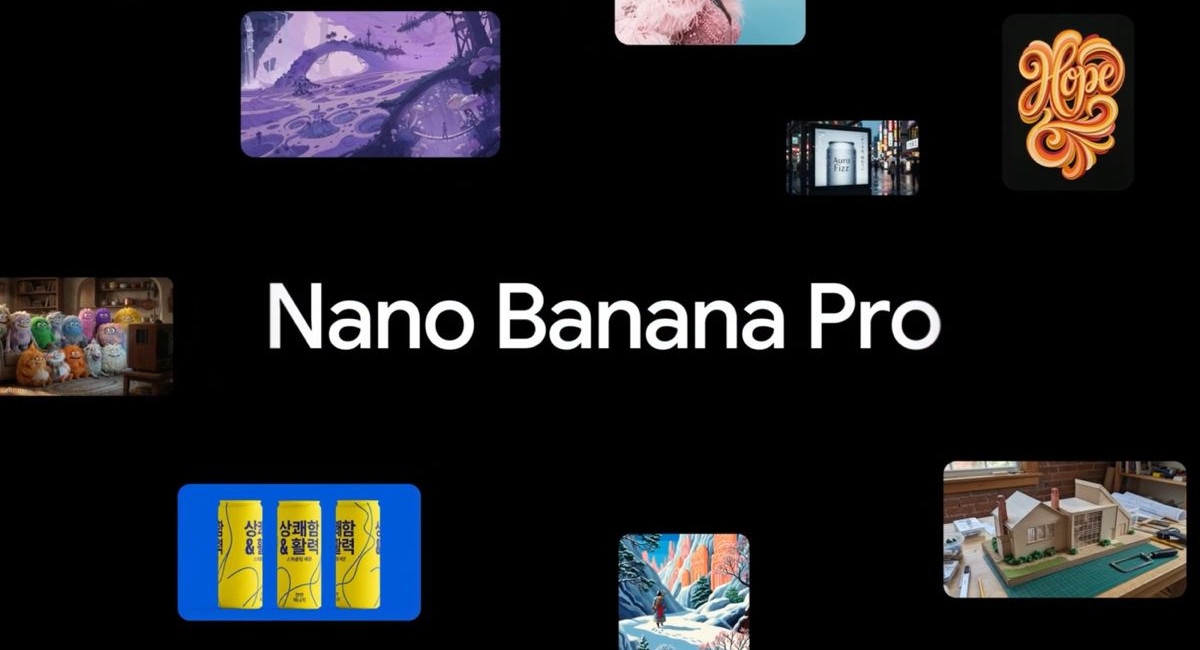
Google is pushing its image-generation technology into a new league with the launch of Nano Banana Pro, a significantly upgraded successor to the original Nano Banana model. Built on the newly released Gemini 3 large language model, Nano Banana Pro is designed to give users far greater control, higher-resolution results, and more accurate text rendering—all while introducing web-search capabilities that allow the model to gather information before creating an image.
The company says the new system represents a major leap forward in realism, detail, and flexibility. While Nano Banana established the foundation for Google’s image tools, Nano Banana Pro aims to serve users who need professional-grade output. One of its headline upgrades is its improved handling of embedded text, traditionally a challenge for image generators. According to Google, the new model can produce readable and stylistically varied text in multiple languages, as well as incorporate custom fonts and design elements directly into the images.
Nano Banana Pro’s web-search integration marks another significant shift. Instead of relying solely on its training data, the model can now query the internet to retrieve up-to-date details. Users can, for example, ask it to find a recipe and automatically generate flash cards or instruct it to gather reference material before producing a visual guide. Google positions this as a step toward image generation that is both more context-aware and more useful in practical tasks.
A key audience for Nano Banana Pro is creative professionals, and the tool reflects this with its expanded manual controls. Users can dial in camera angles, adjust lighting and contrast, manipulate depth of field, refine color grading, and tweak focus—all features reminiscent of professional photography and digital art software. Output size has also been dramatically improved: where Nano Banana maxed out at a 1024 × 1024 pixel resolution, the Pro version can generate images in 2K and even 4K.
The higher quality does come at a cost. Google notes that Nano Banana Pro is slower and significantly more expensive to run than its predecessor. While Nano Banana was priced at $0.039 per 1024px image, Nano Banana Pro costs $0.139 per 1080p or 2K image and $0.24 for a 4K render. The trade-off, Google argues, is justified by the model’s expanded capabilities, which include blending up to 14 objects in a single scene, using six high-fidelity reference shots, and maintaining consistency for as many as five individuals—an important feature for multi-image workflows.
To help users explore these capabilities, Google has released a demo application showcasing the model’s strengths. Meanwhile, Nano Banana Pro is being rolled out across many of the company’s AI products. The Gemini app will now generate images using the Pro model by default, though users on the free tier will have limited access before being switched back to the original Nano Banana. Subscribers to Google AI Plus, Pro, and Ultra plans will receive higher-generation limits, though exact thresholds have not been disclosed. These users will also gain access through NotebookLM and, for Ultra subscribers, the model will be available within the Flow video tool. Workspace customers will find the model integrated into Google Slides and Vids.
Developers are not left out of the update. Google is making Nano Banana Pro accessible through the Gemini API, Google AI Studio, and its recently introduced IDE, Antigravity. This broader access suggests the company is eager to see the technology embedded into third-party applications and creative pipelines.
Google is also expanding its efforts to track and identify AI-generated images. Nano Banana Pro includes support for SynthID, the company’s watermarking and detection technology. Users will be able to upload an image to determine whether it was created or modified by Google’s models. Over time, Google plans to build in C2PA content credential detection to help verify the authenticity of digital media.
MORE NEWS FOR YOU