Help & Support
SEARCH
OpenAI eliminates the awkward Meeting Bot
SHARE IT
The routine of modern office work has long been burdened by an unresolved dilemma: actively engaging in high-stakes discussions or furiously typing notes to document what was said. Over the past few years, artificial intelligence promised relief through automated transcription assistants, yet their visible entry into virtual conference rooms has often introduced social awkwardness, administrative friction, and heightened surveillance concerns. OpenAI is now addressing this pain point directly with the release of its new Meetings Plugin, embedded directly within the ChatGPT desktop application for macOS. Designed for Pro and Business subscribers, the feature signals a major step toward ambient workplace intelligence, turning raw conversational exchanges into structured, actionable business documentation without a digital spectator hovering on the screen.
Unlike prevailing market alternatives such as Otter.ai or Fireflies that routinely dial into Zoom, Microsoft Teams, and Google Meet as invited participants, the engineering approach taken by OpenAI operates discreetly under the hood. By securing permissions at the operating system level on Apple computers, the utility captures incoming system audio and the local microphone feed simultaneously. This architectural design decouples note-taking from the underlying communications platform. Whether an enterprise team conducts an executive briefing on Microsoft Teams, an informal sync via a web browser, or a private call through proprietary internal software, the tool processes the audio feed invisibly, preserving the natural visual aesthetic and professional cadence of the conversation.
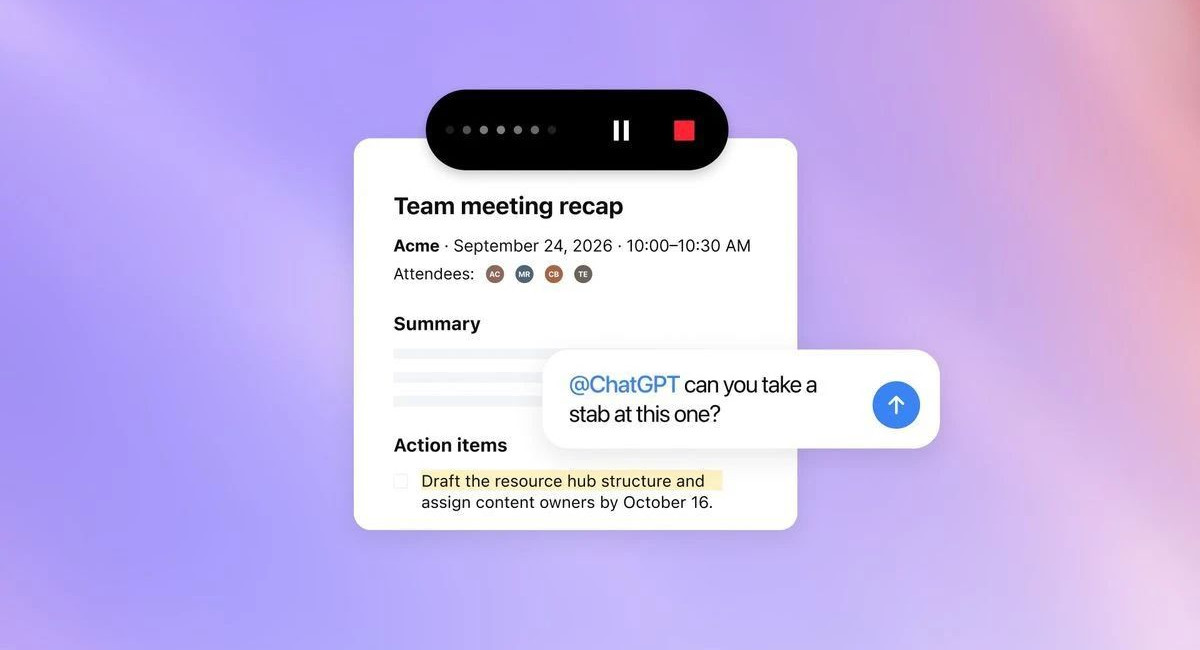
Raw transcripts have traditionally suffered from being overwhelming and underutilized, generating walls of text that demand substantial manual effort to extract value. OpenAI bypasses this limitation by channeling captured dialogue into ChatGPT Space, where generative language models transform spoken exchanges into contextual productivity assets. Once a call concludes, the plugin reconciles the acoustic transcript with any concurrent personal notes taken by the user, alongside contextual records pulled from connected workplace software. Rather than merely archiving dialogue, the system isolates high-priority takeaways, drafts customized project milestones, and prepares cohesive follow-up emails ready for distribution with a single prompt.
Corporate apprehension regarding data privacy and intellectual property exposure has naturally intensified alongside the rapid adoption of enterprise artificial intelligence. Business meetings routinely touch upon confidential personnel matters, strategic initiatives, pricing negotiations, and unreleased financial metrics. In response to these compliance sensitivities, OpenAI built an ephemeral processing pipeline. Audio captured from the host computer streams encrypted to remote servers solely for real-time transcription. The moment processing concludes, the underlying audio files are permanently purged from server infrastructure, leaving zero cached audio recordings or playback capabilities behind.
This privacy architecture ensures that meeting records remain entirely private and accessible solely to the account holder. The software does not broadcast summaries across shared organization channels, leaving full discretion with the individual professional to distribute documentation to team members. However, this model introduces an important operational reality: the legal and ethical responsibility of participant consent rests entirely upon the user initiating the recording. Because there is no conspicuous digital avatar announcing its arrival in the virtual waiting room,organizations must depend on human transparency and organizational compliance policies to navigate multi-party consent regulations.
Currently deployed in a Beta phase, the rollout is intentionally phased. While macOS users on premium consumer and commercial tiers can immediately utilize the functionality, the vast majority of corporate employees reliant on Windows must wait, though engineering teams have confirmed that dedicated clients for Windows, iOS, and Android are actively in development. Meanwhile, organizations enrolled in ChatGPT Enterprise face an additional waiting period. Given the stringent security controls, data sovereignty rules, and compliance standards demanded by multinational corporations, the enterprise release remains in a closed Alpha evaluation track to validate system resilience under demanding corporate network environments.
As generative technology transitions from isolated chat prompts into continuous ambient workplace utilities, the desktop operating system is rapidly becoming the primary arena for professional workflows. By embedding transcription and contextual analysis directly into the operating system layer, OpenAI is positioning itself to make fragmented third-party meeting extensions redundant. If early performance holds true to its technological promise,transforming spontaneous spoken discussions into polished digital deliverables may quickly become the standard across modern enterprise collaboration.
MORE NEWS FOR YOU