
 Help & Support
 SEARCH
Spotify breaks down Premium wall to offer free safe music haven for kids
SHARE IT
Spotify announced a sweeping expansion of its managed accounts feature, extending comprehensive parental controls to users on its Free tier. The decision effectively dismantles a long-standing financial barrier, allowing parents to secure their children's listening environment without having to purchase a premium subscription plan.
Until recently, the privilege of tailoring a secure, restricted digital space for minors was exclusive to subscribers of the Premium Family tier. By dropping this requirement, the Swedish streaming giant is opening its safety features to millions of households worldwide that rely on the ad-supported version of the app. Under this new framework, children under the age of 13 can explore music independently within a protected ecosystem. Parents can rest easy knowing that while the free accounts will still feature advertisements, Spotify has committed to filtering these promotional messages to ensure they are age-appropriate and primarily focused on helpful in-app guidance.
Beyond the obvious financial relief for families, this rollout solves a persistent headache for parents who share their personal profiles with their kids: algorithmic chaos. Anyone who has ever handed their smartphone to a toddler knows how quickly a few hours of animated movie soundtracks can permanently distort their personalized recommendations. By isolating a child's listening habits into a distinct Managed Account, Spotify prevents this data spillover.
The standalone profile allows the platform's recommendation engine to train itself exclusively on the young listener's actual tastes. As a result, children get their own dedicated custom playlists, including localized algorithmic features like daylist and Made for You mixes. Furthermore, the separation ensures that when December rolls around, the year-end Wrapped statistics remain completely unpolluted. Children will receive their very own musical retrospective, while parents can look back at their actual favorite tracks of the year without any unwanted children's content taking over their top slots.
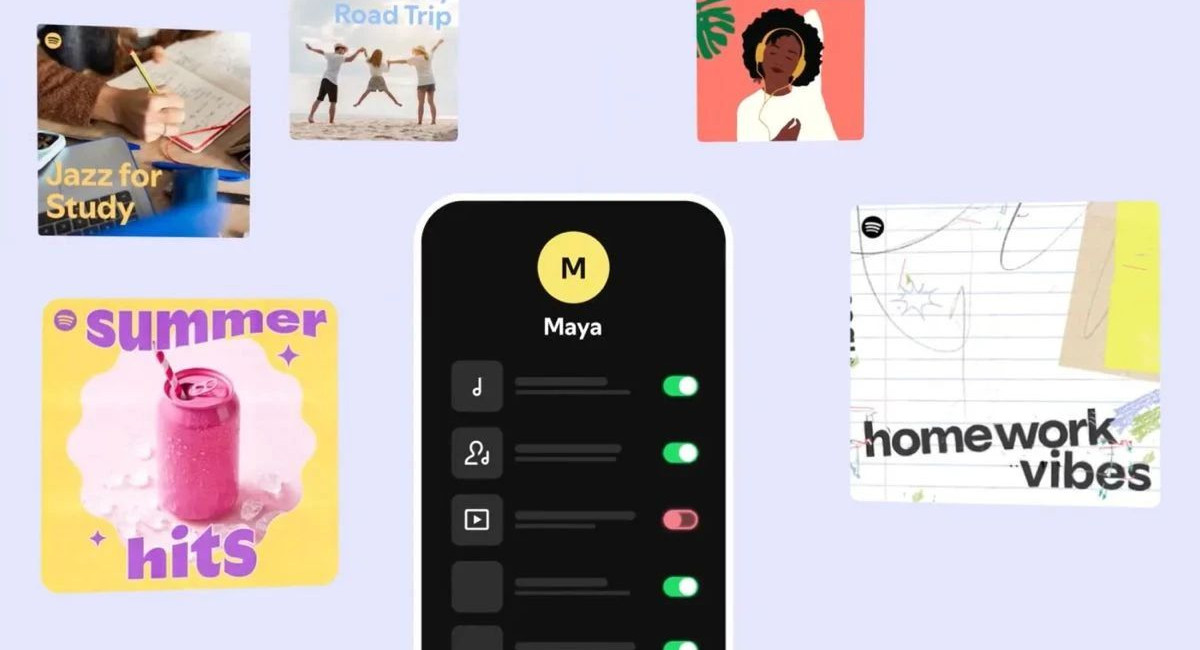
At the core of this initiative is a robust architectural approach to digital safety, reflecting a strict privacy-by-design philosophy. Rather than forcing children to navigate complex settings, Spotify places all administrative power directly inside the adult's primary mobile application. Parents can supervise and adjust the young user's entire experience from a centralized Parental Controls hub, making real-time adjustments as their children grow.
The security package comes with several aggressive default protections. Most notably, explicit content is automatically blocked the moment a new profile is initialized, relying on metadata tags provided by copyright holders to filter out inappropriate lyrics. To shield young users from external digital risks, these accounts are strictly private by default, meaning they will never appear in public search results and cannot be discovered by third parties.
Furthermore, the company has modified the traditional user interface to fit a younger demographic. Interactive features such as instant messaging and in-app purchases are completely deactivated. To ensure the experience remains focused entirely on audio, Spotify has also disabled all heavy visual elements, including full-length music videos and Canvases, which are the short, looping visual clips that usually play in the background of songs.
Initiating this new setup requires no technical expertise and can be handled seamlessly on a standard smartphone. Parents simply open their mobile app, tap their profile icon on the main interface, and navigate to the Add account option to select the feature for creating a managed profile. From there, they can specify a display name for their child and customize the underlying access rules immediately.
The rollout is currently moving through its initial international phase, launching across 16 major global markets including the United States, the United Kingdom, Germany, France, and the Netherlands. While Greece is notably absent from this initial wave, the digital audio provider has officially confirmed that the expansion will arrive in additional territories in the near future, indicating that local families will not have to wait too long to access these free parental tools.
MORE NEWS FOR YOU