 Help & Support
 SEARCH
OpenAI launches ChatGPT Health as a personal health assistant
SHARE IT
In a move that formalizes one of the most popular uses of its platform, OpenAI has officially unveiled ChatGPT Health,a dedicated environment designed to help users navigate their medical information and wellness data. The announcement follows a striking revelation from the company: 230 million people already turn to ChatGPT every week with health-related questions. By carving out a specialized space for these sensitive interactions, OpenAI aims to bridge the gap between scattered medical records and actionable personal insights, all while attempting to address the significant privacy concerns inherent in handling health data.
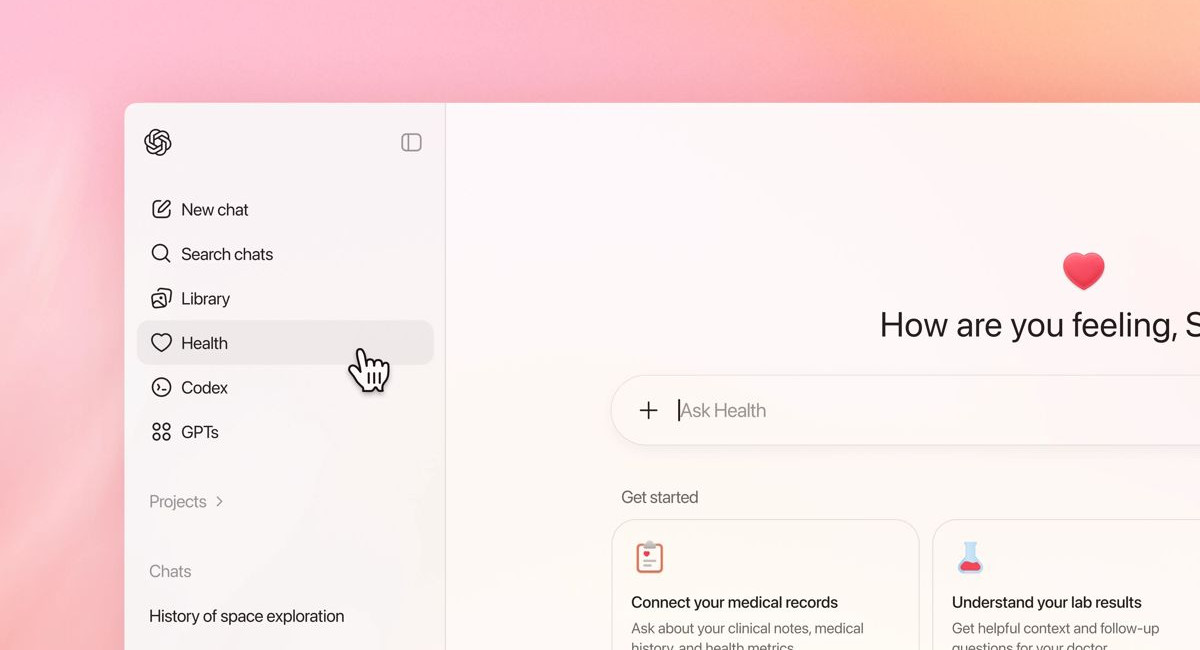
The impetus for this new product is the sheer volume of health inquiries the platform already processes. From decoding complex medical jargon to brainstorming fitness plans, users have treated the chatbot as a de facto health consultant for some time. ChatGPT Health essentially acknowledges this behavior and upgrades the experience from a general chat to a purpose-built tool. The feature appears as a distinct tab within the interface, signaling to the user that they are entering a different mode of operation—one equipped with specific integrations and enhanced data protections.
One of the central promises of ChatGPT Health is its ability to consolidate fragmented information. Through partnerships with health data aggregators like b.well and direct integrations with wellness platforms such as Apple Health, MyFitnessPal, and Peloton, the system can now "see" a user's broader health picture—if the user chooses to grant access. This connectivity allows for far more personalized assistance. For instance, instead of asking generic questions about cholesterol, a user could theoretically upload a PDF of their latest lab results and ask the AI to explain the findings in plain English or compare them to previous metrics stored in their connected apps.
Beyond interpreting data, the tool is positioned as an administrative ally. OpenAI highlights its utility in preparing for doctor visits, suggesting that users can leverage the AI to organize their thoughts, list symptoms, and formulate questions for their physicians. It also tackles the bureaucratic headache of health insurance, offering to help compare plans or clarify coverage options based on a user's specific medical history. These features point to a strategy where the AI acts not as a diagnostician, but as a knowledgeable secretary or translator for the often-confusing language of the healthcare system.
However, the introduction of health-specific AI inevitably brings privacy debates to the forefront. OpenAI has been careful to distinguish this new mode from its standard model. The company asserts that ChatGPT Health operates in a siloed environment where conversations and uploaded files are encrypted and, crucially, are not used to train future versions of their foundation models. This separation is intended to reassure users that their sensitive medical history won't inadvertently influence the AI's general knowledge base. Despite these assurances, the exclusion of the European Economic Area, Switzerland, and the UK from the initial rollout suggests that navigating the strict regulatory landscapes of regions like the EU remains a complex hurdle.
The launch also comes with a heavy emphasis on safety guardrails. Developed in collaboration with over 260 physicians, the system is programmed to defer to professionals. OpenAI explicitly states that ChatGPT Health is not a diagnostic tool and is not a replacement for professional medical care. Its primary function is to support the patient's understanding and preparation, rather than to prescribe or treat. This distinction is vital for avoiding liability and ensuring user safety, though it remains to be seen how effectively the AI can maintain this boundary in practice when faced with urgent or ambiguous user queries.
Availability is currently limited to a rollout for Plus, Pro, and some Free users in the United States and other select regions. As the feature expands to web and iOS platforms in the coming weeks, it represents a significant step in the evolution of consumer AI. By integrating directly with the "quantified self"—our steps, our labs, our records—OpenAI is betting that the future of health is not just about visiting a doctor, but about having an intelligent, always-on assistant to make sense of the data we generate every day. The success of ChatGPT Health will likely depend on whether the convenience it offers can outweigh the lingering public hesitation regarding AI and data privacy.
MORE NEWS FOR YOU