 Help & Support
 SEARCH
OpenAI wants ChatGPT to manage your financial life
SHARE IT
OpenAI has announced a major upgrade that allows ChatGPT to connect directly to personal bank accounts, transforming the popular chatbot from a friendly digital assistant into a personalized financial advisor. While OpenAI views this as a natural progression for a tool already used by millions to discuss budgeting, the move is bound to spark intense conversations regarding data privacy and the expanding boundaries of AI integration.
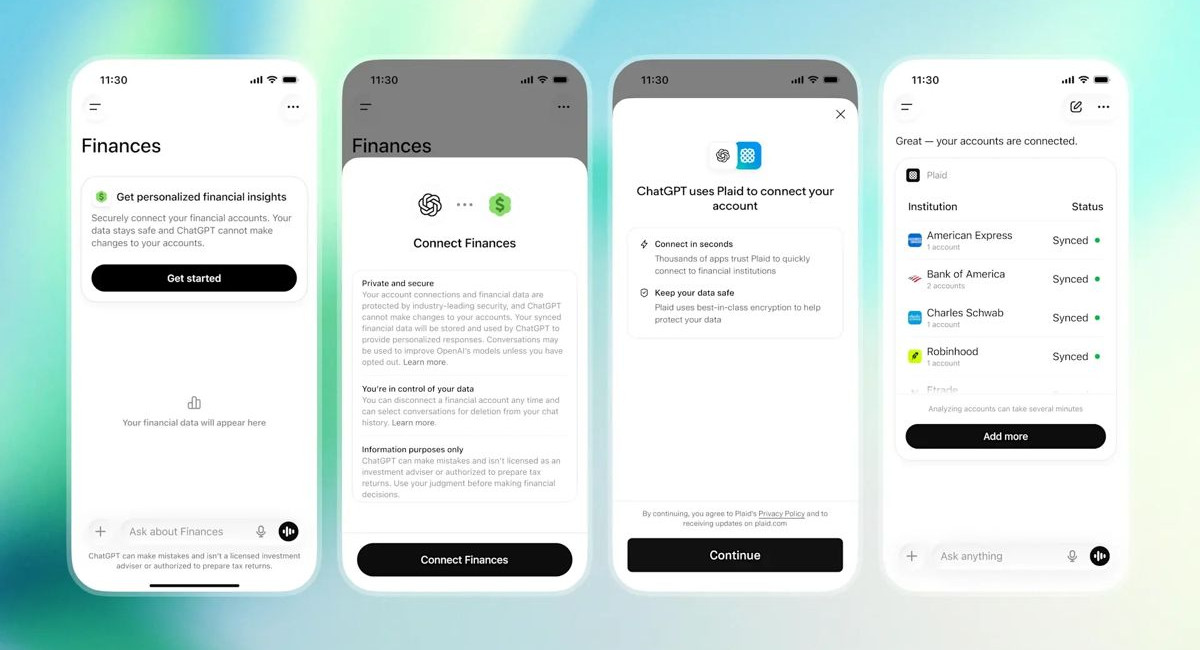
The development is made possible through a strategic partnership with Plaid, a prominent financial data network that securely links tech applications with more than twelve thousand financial institutions. This network includes major industry names such as American Express, Bank of America, Charles Schwab, and Robinhood. By bridging the gap between conversational AI and real-world banking infrastructure, OpenAI aims to capture a massive market of users who are looking for tailored financial strategies but may not have access to traditional, costly human advisors. According to the company, over two hundred million people already turn to the chatbot every month for advice on how to manage their money, making this first-party feature a logical next step.
Unlike the generic financial tips that users previously received, this new integration allows ChatGPT to analyze actual bank statements, transaction histories, outstanding liabilities, and investment portfolios. This contextual awareness enables the AI to deliver highly specific guidance rather than broad financial platitudes. Users can ask intricate, long-term questions regarding their financial goals, such as formulating a realistic five-year plan to buy a home in a specific neighborhood, structuring a monthly budget to purchase a vehicle, or finding a feasible way to pay off personal debts while maintaining a steady savings rate.
To alleviate the inevitable anxiety surrounding automated access to financial data, OpenAI has placed strict limitations on what the system can actually do. Crucially, the feature does not currently include agentic capabilities, meaning ChatGPT cannot execute transactions, transfer funds, or make changes to an account on its own. Furthermore, the AI is blocked from viewing full account numbers. The data ingestion process takes only a few minutes after initial authentication through Plaid, after which the chatbot generates a comprehensive financial dashboard detailing current spending habits, upcoming bills, and overall financial health. For those who remain skeptical, OpenAI has confirmed that users can opt out at any time, disconnect their accounts, and entirely wipe the chatbot's memory of their financial history.
Powering this complex, context-heavy financial ecosystem is OpenAI's latest reasoning model, GPT-5.5 Thinking. Given the high stakes of personal finance, relying on an advanced model capable of deep reasoning and contextual understanding is essential to minimize errors and provide reliable guidance. The feature is currently being rolled out as a preview to a select group of Pro subscribers in the United States, with a broader public release and further integrations, including with financial software giant Intuit, scheduled for the near future. As AI moves closer to our wallets, the line between technology and personal lifestyle continues to blur, leaving consumers to decide just how much of their financial future they are willing to hand over to an algorithm.
MORE NEWS FOR YOU