 Help & Support
 SEARCH
Unfolding the future: Samsung erases the crease with Flex Titanium
SHARE IT
Ahead of the Galaxy Unpacked event scheduled for July 22, 2026, Samsung has officially unveiled Flex Titanium. This groundbreaking display architecture will power the upcoming Galaxy Z Fold8 and Galaxy Z Flip8, promising to eliminate the dreaded crease and drastically enhance device longevity.
Building on the experience gathered over seven generations of foldable devices, Samsung has completely reimagined its screen technology. Crafting a folding panel is a complex equation of material science. The substrates must be tough enough to absorb shocks and flexible enough to survive endless folding cycles, all while maintaining an incredibly thin profile. After extensive laboratory testing, the company turned to a material famous for its resilience in aerospace applications. That material is titanium.
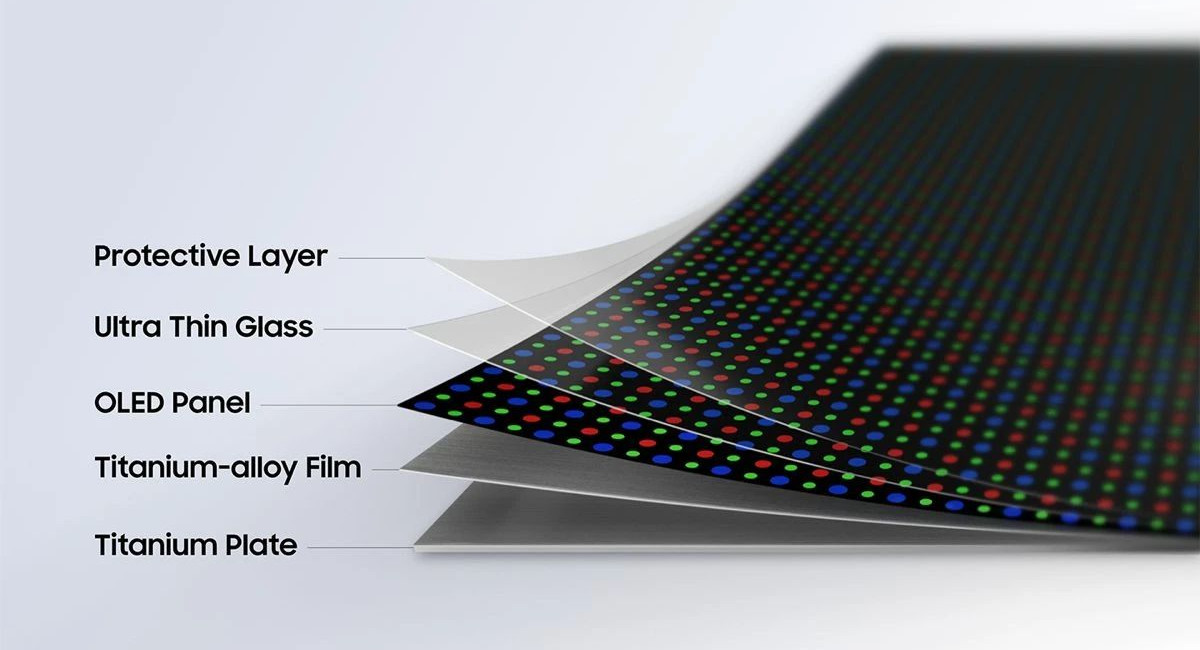
Flex Titanium represents a fundamental shift in hardware architecture. It abandons conventional plastic polymers in the lower display layers, replacing them with two innovative titanium-based components. The first is a titanium alloy film located directly beneath the OLED panel. According to Samsung Display, this layer delivers twenty times more mechanical rigidity than traditional polymer films. Through a demanding precision rolling technique, the material is thinned down to roughly one-third of a human hair. This ensures zero surface distortion while keeping the screen ultra-slim.
Beneath this alloy film lies a flexible titanium support plate. To achieve perfect material cohesion, Samsung utilized advanced perforation technology that entirely eliminates air gaps between the display module and the adhesive holding the structure together.
The true engineering marvel, however, lies at the folding axis. Kyung-Jin Yoo, EVP and Head of Mobile Display Product Development at Samsung Display, detailed that the titanium plate features a sophisticated pattern of microscopic holes exactly where the screen bends. This precise intervention allows the rigid metal to fold smoothly with geometric precision. When unfolded, the structure provides a uniform, flat base that prevents the material from sinking into the hinge, spectacularly reducing the curvature that causes the crease.
Furthermore, Flex Titanium upgrades the OLED panels with next-generation organic materials. These materials maximize resolution and color performance while drastically lowering power consumption, a vital improvement for large inner screens that tend to drain battery life.
As noted by Sunghoon Moon, EVP and Head of the Mobile R&D Office at Samsung Electronics, transitioning to titanium solves practical issues of the past and guarantees long-term reliability. The era of the creased screen seems to be officially over, and the future of foldables looks perfectly flat.
MORE NEWS FOR YOU